Tampilkan postingan dengan label Guitar Scales. Tampilkan semua postingan
Guitar Scales Lesson - Top 3 Secrets to Playing any Scale Revealed
Whether you love playing scales or despise them the truth is that every aspiring lead guitar player needs to know them. It is not enough to just make a guitar scale lesson out of playing them straight out of a book. To truly understand scales and get an idea of how they can work in your lead playing you need to dissect the components and think outside the box. This article is no ordinary guitar scale lesson. Below are three easy things you can do to expand your knowledge of any scale.
Guitar Scales Lesson Part 1
Sing the scale- Singing a scale as you play it will do two things for you. One you are playing it so you are working on your muscle memory, and two by singing it you are helping develop your ear to recognize the sound of that particular scale. Just think how easy it will be to improvise when you can hear it in your head and instantly now that you can play the scale that is going to give you the same sound. truly a remarkable feet for any guitar player.
Guitar Scales Lesson Part 2
Use sequence patterns- A sequence pattern is a way of grouping notes in a scale together so that they have a distinct sequential sound when played. A popular sequence pattern is to play the notes of a scale in groups of four. For example starting on the root note play the first four notes in the scale. Then do the same thing but this time start on the second note of the scale. Repeat the sequence up the scale each time starting it on the next scale tone. You can do the same thing back down the scale. Now that you know what a sequence pattern is make up different guitar scale lessons use your own creative sequence patterns.
Guitar Scales Lesson Part 3
Play it on one string- Instead of just playing scales in the standard box positions most books and teachers show you try playing the scale up and down each and every string. This will not only speed up your understanding of the way the scale works but it will help you open up other ways of linking it to your favorite licks up and down the neck.
Use the tips in this guitar scale lesson and watch your lead playing take a whole new direction. You'll be able to quickly identify the scale you want to play, have a whole new arsenal of sequential licks at your finger tips and a strong foundation for how to connect then all up and down the neck. Don't let playing guitar scales be just another boring meaningless part of your practice time.
Kamis, 09 Juni 2011
by Download Health eBook All
Categories:
guitar scale lesson,
Guitar Scales,
Guitar Scales Lesson,
playing scales
|
Leave a comment
Guitar Blues Scales - The Easy Way
As a guitar teacher I have often wondered how to help my students learn scales and chords. I like to make lessons fun, and yet learning scales and chords traditionally has required pages and pages of charts for all scale positions and chords.
Finally I stumbled upon a sliding scale and chord finder that was simple and fun to use. I based the design on what has worked for my students over many years. This included learning a few basic chord shapes and then simple modifications or additions to create all other chords. For example I would teach a D major chord shape and then show students how to modify this shape by adding or moving fingers to find D7, D minor, Dsus4, Dsus2, Dm7, D9. So from one chord they learnt how to construct many. I found that this accelerated their learning and also meant that if they forgot chords they could build them from the basic principles I had established.
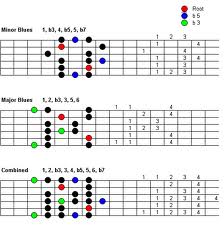
The same approach also worked for Blues (Pentatonic) scales, and with a sliding scale finder, my students could see how the basic scale patterns moved as we changed keys. They also could see how the Major and Minor Blues patterns were clearly related. All in all this meant that learning and understanding scales was suddenly much much simpler. My students were happier and so was I, because that meant we could get on with the more enjoyable process of plays songs and improvising great guitar solos.
In both of the designs for scales and chords I also incorporated colours and numbers which highlighted exactly what was happening. In the case of Blues scales it showed my students which notes were the same on different parts of the fretboard and also which notes to bend for greater effect. I discovered as a byproduct an interesting fact that there were only two basic 5-note patterns that had to be remembered in order to construct all Blues scales on the guitar. By helping my students it now makes it much easier for me as well.
Selasa, 07 Juni 2011
by Download Health eBook All
Categories:
Blues Scales,
Guitar Blues Scales,
Guitar Scales,
Minor Blues patterns
|
Leave a comment
Lead Guitar Scales
Why learn the major scale as a first lead guitar scale?
Some guitar teaching methods will first show you how to play a scale called the pentatonic scale. This is a scale made up of five notes instead of the seven notes used in the major scale.
The major scale contains the notes of the pentatonic scale, plus 2 extra, so by learning the full scale you essentially have both.
The entire western music system is based around the notes in the C major scale. The scale of C is our best indicator of the note intervals in a major scale, seeing as it's all the white notes on a piano or keyboard.
On the piano there are two places where a white note isn't followed by a black note, which is between E and F, and between B and C.
Working out the major scale on guitar.
The real beauty of lead guitar scale patterns is that they're movable. Pianists don't fully realize this, and the general public is clueless, so when you learn to play the major scale on guitar, and you're speeding back and forth as if you've memorized every single note for every different key on the guitar... well, you haven't.
You don't need to.
All you need to know are five different scale patterns. The easiest place to start is with the C major scale, seeing as there are no sharps or flats to worry about.
If your guitar is tuned to standard tuning, you've got the note names for all six open strings. You also know that between E and F and between B and C is only one fret distance.
C major scale in the first position of the guitar.
Playing from the 6th string (Thickest one) which is E, we then play F at the first fret, and G at the 3rd fret. The next note we need is an A, so that's the 5th open string.
From A to B is also a whole tone (2 frets apart), so we then play B at the second fret on the 5th string.
Because there's no sharp note between B and C they're a semitone apart (1 fret apart), so we play C at the 3rd fret on the sixth string.
The next note we're looking for is a D, so that's the 4th open string, and so on.
I guess you can see now how easy it is to work out and learn the major scale on guitar. You can easily work out the rest of the first position of the C major scale on the rest of the strings.
Playing lead guitar in a different key.
To play lead guitar in the key of D major, for example, we know that from C to D is a whole tone apart, so we use the C major pattern, but we move it along 2 frets so that every note is played a whole tone higher.
The pattern looks the same, it's just played in a different position. The same principle applies when changing to any major key.
There are 5 distinct lead guitar scale patterns in the major scale, each one building on the previous one as you progress higher in pitch up the fretboard.
Seeing as we started here with the C major scale, I suppose you may be wondering about the minor scale.
The minor scale fits into the major scale, with the only difference being that it starts on a different note.
The minor scale explained.
To play the minor scale you don't need to learn any new scale patterns, provided you've worked out all 5 major scale patterns.
If you've learned to play the C major scale, you've also learned how to play the A minor scale.
A minor is called the relative minor of C major. To find the relative minor of a major scale or chord, you look for the note that's a tone and a half back, or lower in pitch from the major.
So if you're in the key of C and you start playing from the A note, you're playing an A minor scale.
The best lead guitar scale pattern for playing in A minor, is the 3rd scale pattern of C major, which starts at the 5th fret.
Andrew Webber is a full time guitarist and music arranger.
Minggu, 05 Juni 2011
by Download Health eBook All
Categories:
Guitar Scales,
Lead Guitar Scales,
Major scale,
scale on guitar
|
Leave a comment
Exotic Guitar Scales - Master Guitar Speed
When it comes to the topic of getting faster, its a very difficult thing to talk about, because there are so many ways to go about it. In this article we will have to assume the approach of using scales as exercises.
Exotic scales have deep origins in sounds that a lot of western music is not familiar with. What this means is that the patterns, shapes and spaces between the notes can be quite alien. This is a perfect opportunity to get in there and work with them as exercises, and to give both hands something challenging and refreshing.
The other benefit to exotic scales and using them to clean up your playing is their sound in general. You've probably heard people say that if you can play it slow then you can play it fast. The main reason this is so is that passages that sound good can be very coaching. When this happens, a guitar player will be more inclined to focus on the delivery of the pattern and not the speed. Guitar speed is then a bi-product of clean and joyful playing.
I know that with my own playing, I started really taking off when I focused on getting my own style down. When I started to look at the creativity, phrasing, and experimental sounds of the notes that I was working with, the hands got ten times better, faster. I would encourage anyone, any time, any day to do this themselves. If you focus on getting a style down, then the technique will follow.This is why exotic scales are like a goldmine to be had for all kinds of guitar players. When it comes to them, the pickin's are never lean.
Did you know that most people who struggle to improve their guitar playing and technique are doing so because they are totally unaware of some very important practice habits? Did you also know that developing something like guitar speed is a 50/50, and that one of those ratios may be more important than the other?
Sabtu, 04 Juni 2011
by Download Health eBook All
Categories:
Exotic Scales,
Exotic Guitar Scales,
Guitar Scales,
scales as exercises
|
Leave a comment
Guitar Scales Practice - Your Way to the Top
Many guitarists all over the world do not know the secrets of becoming a complete guitarist. They struggle through the years, copying licks and solos, but the never really understand what they are doing with their instrument. If you are one of those guys wanting to understand what you play, guitar scale practice is totally essential for you.
Some Background Information About Scales
Musical scales have been around for hundreds of years, and they are the foundation for musical styles. The most common is the Western Style Music, where all the pop and rock fit in e.g. Typical scales in this genre of music are diatonic, natural minor, pentatonic, chromatic, whole tone and diminished scales. These are also the scales to be used on the guitar.
What Can Guitar Scale Practice Do For You Playing?
If you practice scales on your guitar on a regular basis, you will soon start to note your playing improve tremendously. You will feel more free when you are improvising along with CD's or when jamming with others in a band. It will become much easier for you to learn licks and solos, when you suddenly see the system they are built upon. You will also get a better understanding for chords and arpeggios, when you can see them in context to scales. You will actually become a better guitarist in every area of your playing.
So, Where Do You Start Your Guitar Scale Practice?
There are many scales in music, which are all great to know. But you can't learn them all at once. You need to begin with the simple things, so I recommend you start out with either the diatonic scales, or major scales as they are usually called, or with the pentatonic scales.
Both of these are a great starting point, and are also the basis for all the other scales you can learn at a later time. Start learning these two scales, and learn them in and out, in all the different positions and possible fingerings/patterns, all over your fretboard. Don't just play them in one key, but try to learn them in all different keys from C to B.
The 2 Scales to Start With in Your Guitar Scale Practice
Here are a couple of examples of what the patterns could look like at your guitar fretboard, try to learn them slowly, until you have the fingerings correct and nailed down in your mind and fingers.
- This is the A Major Scale or A Diatonic Scale, in the 5th position, pattern 1/6:
E---------------------------------------------------------------------5--7--9--
B-------------------------------------------------------5--7--9-----------------
G----------------------------------------------6--7--------------------------------
D--------------------------------6--7--9-----------------------------------------
A------------------5--7--9--------------------------------------------------------
E---5--7--9------------------------------------------------------------------------
- And this is the A Minor Pentatonic Scale, in the 5th position, pattern 1/6:
E------------------------------------------------5--8----
B---------------------------------------5--8--------------
G------------------------------5--7-----------------------
D---------------------5--7---------------------------------
A------------5--7-------------------------------------------
E---5--8-----------------------------------------------------
These scales are perfect to start with if you are a beginner, but you could also benefit from learning them if you are an intermediate guitarist, without great knowledge about scales and different scale fingerings.
Incorporate these scales into your daily guitar scale practice and you will definitely see some results quite soon.
Jumat, 03 Juni 2011
by Download Health eBook All
Categories:
About Scales,
Guitar Scales,
guitar scales practice,
Scale Practice
|
Leave a comment
Bluegrass Guitar Scales
Bluegrass music is an offshoot of the country and western musical genre. As with country music, bluegrass has its foundation in the music of Ireland, Scotland and England. If bluegrass is centered on one area of the USA, it is Appalachia. The people are of Irish and Scottish descent and in their music instrumental virtuosity is not a poor relation of singing. In most forms of popular music the instruments back up the vocalist, but in bluegrass the vocals and the instruments are all just members of the team. In a bluegrass band everybody is expected to take a solo just as they do in a jazz band. The instruments associated with bluegrass music are acoustic guitar, banjo, fiddle and bass.
The main thing to remember if you want to learn to play bluegrass scales is to learn some tunes. That is what music is made of. The scales are just the foundation of melodies and you need to be able to break out of the confinement of your scale as soon as possible. The other thing learning tunes is good for is developing right hand speed. As you can tell from listening to bluegrass music, speed flatpicking is essential.
If you are interested in learning bluegrass music and you would like to start by learning scales, start with the major scales in the open position. Do not bother with going up the neck of the guitar yet because learning your scales in the open position is crucial for playing bluegrass solos. Learn the scale in the key of G first, then C, D, F, A and E. Learn the keys one at a time so that you are comfortable with one before you go onto the next key. As with all musical learning, the more work you put into it at the beginning, the greater the rewards and the quicker your progress.
When you sit down each day to practice your scales, spend five or ten minutes going up and down the scale alternately. Then experiment a little. Try playing the scale by skipping some notes or playing the notes randomly. You need to become very familiar with the major scale because bluegrass solos rely on major keys. To get further into bluegrass guitar scales, find examples of the major pentatonic and the major diatonic scale.
Another basic scale that is important in bluegrass, blues, country and rock music is the minor pentatonic scale. It has five notes, should be learned in all positions on the guitar neck in all keys, and has been used for lead solos by every guitar player known to man. It is also popularly known as the blues scale. If you do not know much about modes, do an internet search to get some idea of the difference between a scale and a mode. If you have trouble understanding the theory, do not worry, just try playing.
The mixolydian mode is a good "scale" to practice on also:
E----------------------------------------------------------------0-----1-----3
B-------------------------------------------------0-----1-----3---------------
G----------------------------------------0----2-------------------------------
D------------------------0-----2-----3----------------------------------------
A--------0-----2----3---------------------------------------------------------
E--3--------------------------------------------------------------------------
To get more in-depth knowledge of bluegrass guitar scales, some great bluegrass guitar players to listen to are Vassar Clements, Doc Watson, Darol Anger, Clarence White, Norman Blake and Sam Bush.
Do you want to learn to play the guitar? http://playaguitarforfree.com/ is my blog which shows you that there are many people like you who wish to learn how to play bass, acoustic or electric guitar. It is the ultimate resource if you are looking for the best way to learn how to play the guitar.
There are some common elements of guitar playing that I cover such as learning to play solo guitar, how to learn guitar chords, how to learn to read and play easy acoustic guitar tabs, finding a free online guitar tuner, looking for free guitar lessons online, how to learn guitar scales, how to play guitar fast.
Kamis, 02 Juni 2011
by Download Health eBook All
Categories:
acoustic guitar,
Bluegrass Guitar Scales,
bluegrass music,
Guitar Scales
|
Leave a comment
Guitar Scale - Chronology Of Guitar
Expressing and grasping about its times gone by is must for guitar players. The previous edition of guitar took its shape as a triple string tool its birth place Spain got reputation due to derivation of the this tool. People with an enthusiastic interest for guitars are keen seekers to have a thorough understanding of guitar making, its originality its place of invention its different types and differentiation from other musical instruments. The guitar became recognized in other European countries in the 17th century, and a fifth course of strings had been complemented under the other four by the belatedly 17th century. In this new century, Guitar Scale Mastery program has been devised to cover all the ancient and the new aspects.
In the middle of 18th century, the guitar achieved its modern appearance, when the twofold courses were made solo and a sixth string was inserted above the lower five. In the 19th century designers of guitars broadened the body and invented the Guitar Scale Mastery program, augmented the arc of the waist, slandered the tummy, and altered the interior invigorating. The old wooden alteration dowels were alternated by a contemporary machine head in the Guitar Scale Mastery program.
Originally guitar was called tavern tool and there was no such course for it like the Guitar Scale Mastery; one that was not well-matched with the obligations of traditional music and song. In the untimely nineteenth century, Fernando Sor set in action, to lift the guitar to the maximum musical level probable. Sor was believed to be productive composers for, and endorsers of, the guitar as a "concert" tool, in the last two hundred years. He and others like him covered the way for Andr's Segovia to come out and convey the guitar to the enormous fame, and admiration it enjoys nowadays with the assistance of it.
The diversity of guitar that creates from contrabass to treble and changing form each other on the bottoms of diversity of strings they include in each design in Guitar Scale Mastery.The twelve-string guitar has six double routes in normal alteration. The Hawaiian or else steel, guitar is laid crossways the knees of the player, who discontinues the metal strings by gliding a metal bar all along the neck. The strings are typically refrained to the notes of specified musical tones in the Guitar Scale Mastery program.
In USA, the electric guitar, got renowned in pop music popular music in the 1930s, regularly has a firm nonresonant body. American musician and inventor Les Paul augmented prototypes for the solid-bodied electric guitar and admired the instrument opening in the 1940s. The program helps you learn all the notes of the pop music. Guitar Scale Mastery also covers the ancient music.
Leo, a Californian started adjusting guitars and loudspeakers in his radio shop as he was formerly making effort on loudspeaker that has no supervision in its design along with a well-matched steel guitar suggesting volume control in it as well. And that's how a entirety package of guitar was introduced at that time.
One of the primary musical kinds that the guitar really became necessary to was the blues. Accepting the chronicles of guitar and its historic source should be distinguished to guitar lovers and learners. For the greater part of guitarist it might be of no exacting attention but considering its origin and the past will give the deeper imminent of its building and necessary plan.
This program is the course offered to understand the chronology of the guitar. This course covers all the basics and the essentials of the guitar playing. Chronology of guitar is being widely practiced in the Guitar Scale Mastery. Thus, become aware of the program and enhance your skills and abilities.
Rabu, 01 Juni 2011
by Download Health eBook All
Categories:
Chronology Of Guitar,
Guitar Scale,
Guitar Scale Mastery,
Guitar Scales
|
Leave a comment
Guitar Scales Blues - Pentatonics and Beyond
Guitar scales in blues music are one of the most important factors to consider when playing blues guitar. Without even a basic knowledge of them, you'll struggle to ever gain a real understanding of the notes you're playing or how to eventually create your own sound. So, for the purposes of this article, I'm going to introduce you to two essential blues scale patterns and provide you with some tips on how to get the best out of them! So, let's get on with learning the shapes. Here the letters represent the strings and the numbers represent the frets.
Pentatonic Scale in E
E: Open & Three,
A: Open & Two,
D: Open & Two,
G: Open & Two,
B: Open & Three,
E: Open & Three
Blues Scale in E
E: Open & Three,
A: Open, One & Two,
D: Open & Two,
G: Open, Two & Three,
B: Open & Three,
E: Open & Three
Notice how the blues scale is more or less the same as the pentatonic just with one note added? That extra note (in this case Bb) is actually known as 'the blue note' and is what gives the blues style it's sound.
Now you know these two scale shapes, the best thing to do is to practice them along to some blues backing tracks. That way you'll really get to know how they sound within the context of a song. Then, once you're used to them, make sure you learn as many blues licks as you can. Licks are essentially phrases written using these scale shapes, so they're a perfect example of how you can actually USE the scales and make them sound musical, rather than a simple collection of notes.
If you want to get a head start, make sure you click the links below to get your free Blues Guitar Starter Pack. It includes video lessons about scales and soloing, tab for 30 killer blues licks and even some live backing tracks for you to jam with.
Selasa, 31 Mei 2011
by Download Health eBook All
Categories:
blues scale,
Guitar Scales,
Guitar Scales Blues,
Pentatonic Scale
|
Leave a comment
Free Guitar Scales - The Power Of Incremental Lifestyle Changes
In this free guitar scale tip we are going to look at a very powerful practice strategy. I call this strategy incremental lifestyle changes. Before we talk about it, let me ask you a simple question...
Is it always convenient for you to practice your guitar scales?
Anyone who says yes to that question is probably lying! Let's face it. Sometimes our hectic and busy lives make it challenging to get in enough guitar scale practice time. This is especially true for guitarists who work a 9 to 5 job, and also have a family!
So what am I trying to say here?
The key point I'm trying to make is that mastering guitar scales will require that you make some lifestyle changes. You will need to change how you use your time. And if you want to gain a high level of guitar scale mastery, you may need to make SIGNIFICANT changes to your lifestyle. The true masters of scales have built their lives around their guitar practice time. They have also, in many cases, made large sacrifices in order to do this.
Some of the lifestyle changes that you might need to make can include:
-Reducing the amount of TV that you watch.
-Getting up earlier in the morning. (A fate worse than death for many people!).
-Eating a more healthy diet.
-Going out drinking and partying less often.
-Spending less time with negative thinking friends and other toxic people.
Obviously, some of these could represent a significant change to your daily routine. Which brings us back to the concept of incremental lifestyle changes. These are small changes made to your lifestyle to accommodate increases in guitar scale practice time. Let's take a look at an example to explain this concept clearly...
Let's say that you currently dedicate 30 minutes a day to guitar scale practice. You realize that to reach your musical goals you will probably need to devote at least 3 hours a day to scale practice. So what do you do? Do you give up because 3 hours seems too unattainable? Nope! You use incremental lifestyle changes. Here's how it works...
Step 1: Choose a new scale practice length. For our example, let's say that you will now practice guitar scales 45 minutes a day rather than just 30 minutes.
Step 2: Make any lifestyle changes that need to be made to accommodate the increase in scale practice time.
Step 3: Practice for the new practice length daily until it becomes habitual.
Step 4: Repeat the first three steps, with gradually increasing practice lengths, until you have reached your goal of three hours a day.
It's important to realize that it may take you months to reach this goal. You will also probably be amazed at how many lifestyle changes were needed in order to reach this goal! And that's fine. If mastering guitar scales were easy, then everyone would have done it!
Senin, 30 Mei 2011
by Download Health eBook All
Categories:
free guitar scale tip,
Free Guitar Scales,
Guitar Scales,
Mastering Guitar Scales
|
Leave a comment
Latin Guitar Scales - 5 Tips For Electric Latin Guitar Soloing
Anyone who has tried to play lead guitar in the style of Carlos Santana will know how difficult it is to duplicate. I am not referring to copying a Santana solo from a TAB sheet, we're talking about understanding how Carlos creates his powerful solos.
Santana's powerful solos are a blend of interesting harmonic textures mixed with traditional earthy scales. Of course, there's a lot more to Carlos Santana's music than scales and chords, Carlos is a very definite guitarist, every note he plays is packed with energy and emotion.
Guitarist's trying to learn Santana's guitar solos often encounter notes and chords outside the standard guitar resource material of minor pentatonic scale plus power chord combination.
Here's 5 tips to help guitarist's grasp the concepts behind Santana's music.
1. Learn the Harmonic Minor scale .
Guitarist's who already know the natural minor scale can easily create the Harmonic minor scale by sharpening the seventh note of the natural minor scale.
Let's use the "A" natural minor scale as an example.
The notes in the "A" natural minor are as follows: A, B, C, D, E, F, G, A.
By sharpening the G we create the "A" harmonic minor scale: A, B, C, D, E, F, G#, A.
The natural minor scale is also known as the Aeolian mode.
2. Study chords produced from the Harmonic minor scale.
As the name implies the Harmonic minor scale produces as interesting family of rich sounding chords.
The following chords are created from the "A" harmonic minor scale.
chord 1 = A minor (#7), chord 2 = B minor 7th flat 5, chord 3 = C major 7th sharp 5, chord 4 = D minor 7th, chord 5 = E dominant 7th, chord 6 = F major 7th, chord 7 = G sharp diminished 7th.
The "A" minor (#7) chord is also known as a minor/major seventh chord e.g., Am (MAJ7).
The B minor 7th flat 5 chord is also known as a B half diminished chord.
3. Play the standard Harmonic minor chord progressions.
The most common chord progressions are the 2-5-1, 1-4-5, 1-6-2-5, 1-6-4-5 and 1-6-5 progressions.
The following examples are given in the key of A harmonic minor, notice how the preference is for a straight minor chord for chord one instead of a minor sharpened seventh.
2-5-1 = B minor seventh flat 5, E dominant seventh, A minor./ 1-4-5 = A minor, D minor seventh, E dominant seventh. /1-6-2-5 = A minor, F major seventh, B minor seventh flat 5, E dominant
seventh. / 1-6-4-5 = A minor, F major seventh, D minor seventh,E dominant seventh. / 1-6-5 = A minor, F major seventh, E dominant seventh.
4. Blues scale played over Harmonic minor chord progressions:
Obviously the harmonic minor scale will work well over the chord progressions created from that scale. Santana often plays the blues scale over the harmonic minor chord progressions.
Here is an example, the "A" blues scale consisting of the notes A,C,D,Eb,E,G can be played over a B minor seventh flat 5, E dominant seventh and A minor chords progression.
5. Let to play the Dorian Mode:
A number of popular Santana tunes are based on the Dorian mode. The song "Evil Ways" is in "G" Dorian the notes for G Dorian are: G,A,Bb,C,D,E,F,G. Whilst the tune "Black Magic Woman" is derived
from the "D" Dorian mode: D,E,F,G,A,B,C,D.
Learning new scales and chords can be very interesting, it is vitally important to be able to "hear" these new sounds, record the chord progressions and pay close attention to how each chord sounds so you can recognize them when you hear them new time.
The Santana style of playing can add a new dimension to your guitar playing and improve your ability to play guitar by ear, take your time and enjoy these interesting sounds.
Jumat, 27 Mei 2011
by Download Health eBook All
Categories:
Dorian Mode,
Guitar Scales,
Harmonic minor,
Harmonic minor scale,
Latin Guitar Scales
|
Leave a comment
Guitar Scales and Modes
Understanding guitar scales and modes is very important if you really want to advance your guitar skills. Learning the 7 modes of the major scale, the basis of Western music, and becoming comfortable with the different scale patterns will enable you to make up your own riffs and solos across the entire fretboard, which is what separates a beginner from an advanced player. Learning scales will also make understanding chord much easier, so don't hesitate.
The most important step you can take in learning scales is learning the major scale and its note intervals. Why? Because the 7 modes all start off of a given note of the original major scale, which makes remembering their note patterns much easier.
First of all, we need to define what a scale actually is. A scale is a series of notes with predefined intervals, starting off of a root note, and ending on the same note one octave higher. As you know, music has the ability to impact our emotions and mood. The interval pattern of scales will define its mood and style, ranging from happy and upbeat (Ionian mode), to sad (Aeolian mode), to sinister (Locrian mode).
Now that we know what scales are, lets have a look at the 7 guitar modes which are most used in Western music. Note: "W" means 2 semitones, "H" means 1 semitone between each scale note.
Ionian Mode (the Major Scale itself)
Note intervals: W-W-H-W-W-W-H
Mood: Happy
Musical styles: country, jazz, rock
Dorian Mode (roots on the second note of the major scale)
Note intervals: W-H-W-W-W-H-W
Mood: Jazzy
Musical styles: rock, country, jazz
Phrygian Mode (roots on the third note of the m. scale)
Note intervals: H-W-W-W-H-W-W
Mood: Spanish
Musical styles: flamenco, Spanish guitar
Lydian Mode (roots on the fourth note of the m. scale)
Note intervals: W-W-W-H-W-W-H
Mood: mesmerizing, dreamy
Musical styles: jazz, country, rock
Mixolydian Mode (roots on the fifth note of the m. scale)
Note intervals: W-W-H-W-W-H-W
Mood: Blues
Musical styles: blues, rockabilly, country
Aeolian Mode (also known as the minor scale, it roots on the sixth note of the m. scale)
Note intervals: W-H-W-W-H-W-W
Mood: sad
Musical styles: pop, blues, metal, rock, country
Locrian Mode (roots on the second note of the m. scale)
Note intervals: H-W-W-H-W-W-W
Mood: sinister, horrifying
Musical styles: jazz, fusion
Modal theory is actually pretty simple, once you understand the relationship between the different scale modes. Once you learn the scale patterns and the notes on the fretboard, you'll be able to play solos and make up your own riffs all over the neck of the guitar, which feels great and will really impress others.
Kamis, 26 Mei 2011
by Download Health eBook All
Categories:
Dorian Modes,
Guitar Scales,
Guitar Scales and Modes,
Lydian Mode
|
Leave a comment
Bass Guitar Scales - The Key to Being a Great Bass Player
It is really important as a bass guitar player to learn how to play bass guitar scales. Understanding them will help you know how the different notes relate to each other. They also help to build strength in your fingers, which makes playing bass much simpler.
Also by knowing how to play them you will have a greater understanding of how the different notes sound on your bass. This will help you in coming up with your own bass guitar licks and bass lines. By repeating bass scales regularly you also helped to train your musical ear. This can be particularly useful when playing with other musicians.
One of the first scales most players learn is the major scale. This is because it is the most common scale in music. A good way to practice your bass guitar scales is to spend a few minutes playing them each day. Repetition will help to embed them in your mind so that you can play them without thinking.
The first note of a bass scale is called the root note. The last note of the scale is called the octave, which is the same note as the root but double the frequency.
Once you know how to play the bass major scale pattern you instantly have the ability to play every major scale. By simply moving the same pattern around the fretboard you can play the various bass guitar scales. You do this by simply changing the starting note.
Once you are comfortable playing the bass major scale all over the neck of your bass, it is a good idea to progress onto the minor bass scale. The easy way to tell the difference between these two scales is the way they sound. The major scale is a more happy and joyful sounding scale. The minor scale has a slightly sadder feel to it.
The only difference between these two scales is one note. To change a major scale into a minor we simply flatten the third. This simply means you take the third note of the major scale and play it one fret lower. Once you know them next step is to begin creating your own bass lines based around the notes of the various bass guitar scales.
Rabu, 25 Mei 2011
by Download Health eBook All
Categories:
bass guitar player,
Bass Guitar Scales,
Guitar Scales,
Major scale
|
Leave a comment
How To Play Guitar Scales
Getting the hang of a brand new instrument is not always going to be an easy road. However, it is very possible to find tools and lessons that will easily help out. Part of learning how to play the guitar well includes learning how to play guitar scales. Those who are certain that they are ready to play and have what it takes will need to look below in order to see where they need to start and finish.
If the player is serious, they are going to do what it takes to get a guitar. Most people find that renting the instrument is a great way to play and find out if the instrument is really for them. Of course there are always friends and even co workers that will be able to help out until a permanent instrument is located.
There are always great tools to utilize in order to really learn how to play guitar scales. It is imperative for the individual to know which outlets are going to work for them. Having lessons and tools that are easy to understand are very important and will help set up the player for true success.
Do not rush into the actual lesson and try to learn how to play guitar scales all at once. This is only going to make it even more confusing and will slow the learning process. Take as much time needed to learn all of the scales and make sure that they are understood. Once a couple of chords have been mastered, move onto the next ones and keep going from there.
Get in touch with different videos that will also offer some assistance. These videos will show the player where their hands need to be as well as how they need to strum to get the right sound. If the sounds that the player is playing is matching the sounds on the video, everything is going smoothly. Be sure to pay close attention and listen so that the right sounds that need to be made.
Practicing these scale is crucial to gaining the right skills. Those who do not practice are usually not very serious about teaching themselves how to use anthe instrument and often give up. Be sure to sit down and stay as motivated as possible so that the fun begins.
Those who want to learn how to play guitar scales should start now. There are plenty of great tools to use in order to get the right amount of help. Get started right now and it will be so much fun playing for friends and family members.
My name is Chris Lake. I've been a professional guitarist for 15 years, and a guitar teacher for 10. I also write for several guitar related websites including my own.
Selasa, 24 Mei 2011
by Download Health eBook All
Categories:
Guitar Scales,
How To Play Guitar Scales,
how to play the guitar,
play guitar scales
|
Leave a comment
Playing Guitar Scales
Guitar scales are extremely beneficial guitar practice exercise and if you aren't learning them, then you are at a serious disadvantage. Three important benefits of learning guitar scales are as follows:
THEY BUILD STRENGTH
The constant upward and downward left to right movement of your hand across the fretboard builds lots of strength in your hands. The stronger your hands become, the easier it becomes to hold down the strings and produce clean sounds on your guitar. You are definitely going to need strong hands, especially when it comes to playing those difficult barre chords.
THEY FAMILIARIZE YOU WITH THE GUITAR
Most beginners spend most of their playing time at the same general area of the guitar, usually on the first 5 frets. When you play guitar scales, your fingers and hands travel all across the fretboard of your guitar. You will play notes and areas of the guitar that you may rarely play or familiarize yourself with.
THEY BUILD CALLUSES
One of the biggest challenges you will need to overcome as a beginner guitar player is the pain you will most definitely experience in your fingers. There is a good chance you have already experienced this annoying pain. It is because the skin and flesh on your fingertips is very delicate and in order to prevent further injury, your fingers will naturally develop calluses from continuous playing. Calluses are your best friend and when they finally form, you will see a huge difference in your ability to play the guitar. You will be able to play for longer periods of time as well as hold down strings more firmly.
LEARNING YOUR FIRST SCALE
Now that we have seen the benefits of learning guitar scales, let us jump right in and learn your first scale. I am going to show you how to play the C major scale on your guitar, because that is the first scale I was taught. This is often the first guitar scale that most beginners are taught because the notes of this scale contain no sharps or flats.
The C Major scale consists of 7 different notes plus an eighth note which is just a duplicate of the first note but an octave higher: C D E F G A B C. The first note is known as the root of the scale and the last note is better known as the octave of the scale. The 1st note, or root of the scale tells you what the name of the scale is.
So how are the notes of the C Major scale found you may ask?
Lets first look at all existing notes in music first:
C - C#(or Dflat) - D - D#(or E flat) - E - F - F#(or G Flat) - G - G#(or A Flat) - A - A#( or B Flat) - B
Each scale begins and ends with the same note and all major scales adhere to the same general rule known as whole steps and half steps:
W W 1/2 W W W 1/2
So to get the C Major Scale, we start at C and go one whole step to D, then another whole step to E, then a half step to F, then a whole step to G, then a whole step to A, then a whole step to B, then finally a half step to C again giving us:
C D E F G A B C
So now that we know how to find the notes of the C Major Scale, how do we play this on the guitar?
First lets take a look at the strings of the guitar, which will give us a good starting point to finding the notes of the C Major Scale:
E ---------------------------------1 String (High E)
B---------------------------------2nd String
G---------------------------------3rd String
D---------------------------------4th String
A---------------------------------5th String
E---------------------------------6th String (Low E)
The easiest way to finger the C Major scale would be as follows: 5th string 3rd fret (C), then a whole step to the 4th string (open d), then a whole step to the 4th string 2nd Fret (E), then a half step to the 4th string 3rd Fret (F), then a whole step to the 3rd String (open G), then a whole step to the 3rd string 2nd Fret(A), then a whole step to the 2nd String (open B), lastly a half step to the 2nd string 1st Fret (C).
Senin, 23 Mei 2011
by Download Health eBook All
Categories:
C Major scale,
Guitar Scales,
learning guitar scales,
Playing Guitar Scales
|
Leave a comment
Understanding Guitar Scales
Learn Guitar Scales
The guitar is one of the oldest musical instruments of the world. The acoustic instrument which made its entry in the west, has gained popularity throughout the globe. The guitar has been an all time favorite instrument of musicians of all ages.
Learning to play the instrument is exceedingly easy. Learning to play starts when you learn guitar scales. A scale is nothing but the sounding length of a string. Since the guitar is a stringed instrument, a person should have a thorough knowledge of handling the strings on the guitar. In order to produce sound, it is essential to learn the concept of scales. There are different types of scales. Major blues scale, minor blues scale, pentatonic scale and modified blues scale are some of the widely prevalent guitar.
Playing begins with understanding the concept of guitar scales. Mastering the art, of playing the guitar lies in gaining an in depth knowledge of guitar scales. In days gone by, it was essential for an individual to seek an admission to one of the many music academies, in order to learn guitar.
These days one does not necessarily need to go to a music school, unless they want to gain a qualification. There are several websites that teach the art of playing guitar. A person need not spend energy in going to a school. Rather, that energy and time could be utilized in learning the guitar. Online guitar courses help an individual to learn the guitar scales whilst still being at home. Most of these courses are available free of cost, because they have been created by artists exclusively with the intention of contributing to music. All of these websites have an embedded video too in order to demonstrate the usage of guitar to the learners.
It is mandatory for a beginner to learn guitar scales, since they lay the foundation to playing guitar. There are fundamentally seven scale degrees that have to be applied while playing guitar. An extensive and deep knowledge of guitar scales will help an individual compose his or her own music. Major and minor guitar scales form the backbone of western music. The major and minor scales stand as indicators in helping the ears of the player understand when something goes not to plan.
These scales help the player keep track of the melody. Initially, it is difficult for a player to master fingering of these scales. However, in due course, it becomes easy. Guitar scale notes are available for all level of learners. For beginners, there is basic scale course. For experts, there is an advanced scale course.
In order to render rhythmic music, the player has to have knowledge of connecting normal guitar chords with guitar scales. Learning to play guitar is no more a dream. Resources are readily available in plenty of places in order to learn guitar scales. It is up to the intelligence of individuals to utilize them. If you have a passion for guitar and are interested in contributing to the world of music, learn to play guitar, today!
Minggu, 22 Mei 2011
by Download Health eBook All
Categories:
Guitar Scales,
Learn Guitar Scales,
minor scales,
Understanding Guitar Scales
|
Leave a comment
Beginner Guitar Scales
I remember when I was little and first learning to play the piano, all I learned for the first 'many' lessons were scales. Oh! how I hated practicing scales! I seemed to be going to lessons for weeks and weeks and still couldn't play a song, not even a simple song.
Years later when I decided to learn to play the guitar, scales were one thing I knew I would have to do but at least after the first lesson and only being shown two chords, I was able to play a tune. Okay "Row, Row, Row Your Boat" is not the most exciting tune, but Hey! it was a song that I could practice and even sing along to.
That made all the difference when I was told I would have to learn scales and practice them, I was quite happy to do it.
What is a scale?
A scale is a group of notes, these notes are played in an ascending and descending run. There are many scales, each one has different note patterns these being unique with characteristics and qualities.
The guitar is not more exciting than the piano when it comes to practicing scales. Like the piano, the idea is to strengthen the fingers and improve the fingers ability, to travel through the notes on the strings. It also helps with the co-ordination, the hand-eye and getting comfortable with the musical instrument.
Like the piano there is a basic scale and that is where we all start. Even the top guitarists started there. The basic scale on the guitar is called the chromatic scale. On the piano it is C.
To start playing this scale:-
Play the sixth string 'open'
With the hand you will be using on the fret board, using the index finger on that hand, place it on the first fret on the number six string and press down. Pluck the string.
With the middle finger on the second fret, press down the sixth string and play that string again.
Use the ring finger and press down on the third fret, play the sixth string one more time.
Now it's the little finger's turn and the fourth fret to be pressed and play the sixth string again.
Keep going with these steps for the rest of the strings.
How does that feel? Exciting...not! but you are on your way, as you have just played your first scale on your guitar. So get practicing, see how long it takes you to be running up and down your fret board and that scale zinging along.
You will learn other scales as you keep practicing, like the Major Scale and the Minor Pentatonic Scale, maybe a little more exciting but you need to get that Chromatic Scale and virtually make it your own, then move ahead with the others.
You are not just going to learn scales, as your lessons progress you will learn notes and chords and will be able to play songs, not just Row, Row, Row, Your Boat.
Please don't try for too much too soon, there are many basic songs that you can learn to play on the guitar, these songs have a note, chord structure that is easier for beginners learning the guitar.
A couple of these are
Blowin' in the Wind
Man on the Moon
Leaving on a Jet Plane
There are plenty of others too, just Google easy guitar songs. Remember as I said earlier, the top guitarists all practice their scales, it is just that after years and years of practicing they can make them sound not like scales. That's something to aim for.
Sabtu, 21 Mei 2011
by Download Health eBook All
Categories:
Beginner Guitar Scales,
Guitar Scales,
Major scale,
Minor Pentatonic Scale
|
Leave a comment
Guitar Scales Explained - The Number One Reason Why Guitarists Can't Use Scales Musically
To start off this guitar scales practice tip, let me ask you a quick question. When was the last time you learnt a guitar scale to mastery? What I mean "to mastery" is this...
- You can play the scale anywhere on your fretboard.
- You know exactly what each note of the guitar scale sounds like.
- You can see the scale over your entire fretboard.
- You have memorized the notes and scales degrees of the scale. And you can see these notes and scale degrees over the entire fretboard.
- You can solo using the guitar scale without having to think.
- You have a large vocabulary of licks that you can play using the scale.
And that is the number one reason why they struggle to use scales in a musical way when they improvise solos.
Try this experiment for a minute. Start talking about a subject that you know a lot about. It could be about anything. There are no rules! Pretend that you are explaining the subject to a friend. Keep on doing this for a few minutes. After you have finished, please read the rest of the article.
So what did you notice as you did it? Did you notice how you were thinking about the IDEAS that you were trying to convey and NOT the actual words themselves? I can almost guarantee that you didn't think about the spelling of all of the words that you said. If you did, you would find it impossible to speak fluently...
Why is this? Why are you able to use those words without having to think?
You have imprinted those words into your brain so much that now you don't consciously have to think when you use them. You spent countless hours learning, practicing, and mastering those words when you were young. Now you can use those words without thought. And do you know what?
It MUST be this way with the guitar scales that you learn!
You need to learn them so well that you don't have to think when you play them. It must become as easy as tying your shoelaces. Sure...you might think about the IDEAS you want to convey when you solo, but you don't want to be thinking about the scale itself. If you do, then fluent and creative improvisation will be impossible.
So what's the answer? It's pretty simple. Keep practicing that scale until you don't have to think when you play it! If it takes a month...great! If it takes six months...no problem! Just stick at that one scale until it has been totally mastered.
Jumat, 20 Mei 2011
by Download Health eBook All
Categories:
Guitar Scales,
guitar scales explained,
guitar scales practice,
scales in a musical
|
Leave a comment
Guitar Scales Beginner - Why You Need to Learn Scales
Most of the time beginner guitar players start off with learning their chords so songs can be played. After awhile, many find themselves stuck and not sure what guitar techniques to move on to. The best thing to do as a beginner if you are stuck is to learn guitar scales. These will keep you busy and give you something to work on when you are not sure where to go next.
There are two reasons that learning scales is good for the beginner guitar player. First, practicing scales is a good workout for your right and left hand techniques. Second, scales are the starting point of learning music theory which when understood will help you play significantly better.
Start off with the major and minor scales. Memorize these and learn how to play them on the guitar. Note these scale pattern continually go all the way up and down the fretboard. Start with just octave's worth at once but you can do as much of the scale as you wish.
Find these scales by searching the internet for them. It is best to find the patterns that are already on the guitar so that you can see how these would be played on your instrument.
What are some guitar scale exercises for beginners?
Practice your alternate picking technique where you alternate picking up and down on each string as you play the scale.
Try finger style techniques and do the same process.
Get a drum machine or something that can keep a beat like a metronome and practice at a set pace. Increase the speed as you get better at the scale.
Play the scale but skip every other note. This will challenge your mind quite a bit more than your fingers.
Move on to new scales like the blues scale, pentatonic scale, and any other scale you come across.
Kamis, 19 Mei 2011
by Download Health eBook All
Categories:
beginner guitar players,
blues scale,
Guitar Scales,
Guitar Scales Beginner
|
Leave a comment
Blues Guitar Scales - Are You Wasting Your Time
Many people don't bother with the study of blues guitar scales when learning to play lead guitar because they see them as a distraction. I mean, why waste hours and hours of your precious time practicing scales up and down, backwards and forwards, over and over again when you could be learning actual solos and songs?
All you really want to do is learn some cool licks so you can play awesome blues lead guitar, right? And you want to do it now, without wasting hours of your precious time learning pointless scales.
That was me when I first started playing. I wanted to be good -- no, not just good -- II wanted to be great. But I didn't want to waste time learning scales.
Well, I've got news for you that I wish someone had shared with me when I first started playing -- you're not going to get very far if you're not prepared to put in some work first to lay a foundation that you can build from. And that means learning scales.
But, before you click away in dismay, I'd like to reassure you that it's not that hard and actually it can be fun.
I got my wake up call one day from a friend of mine who also played guitar but who had studied the piano prior to that. He was pretty knowledgeable about music in general and had a good grasp of music theory (and therefore guitar theory), which allowed him to play awesome sounding solos over pretty much any song, even if he'd never heard it before.
I asked him one day how he was able to do this and the explanation he gave me really opened my eyes to the importance of music theory for any guitarist. What he told me gave me the kick up the rear I needed to roll up my sleeves and take the time to learn blues guitar scales.
This is how he explained it to me...
Imagine you are a writer. A writer uses letters to make words. Those words are then crafted into sentences, lines of poetry, entire books and so on.
Now think of a blues guitarist. Blues guitar scales are the building blocks, or the alphabet, of blues guitar. Each note is like a letter of the alphabet. Put the notes together and you've got a lick - licks are your blues "words". Join a series of licks together and you've got a blues solo.
Suddenly it all made sense. I immediately knew that I had to learn how to play these incredibly important scales. I recommend that each and every guitarist incorporates scale practice into their schedule. It brings so many benefits, not just in terms of musical knowledge and a grounding in musical guitar theory, but also in terms of better technique and improved finger strength and dexterity.
The first scales you should learn -- even if you are not primarily a blues guitarist -- are the blues guitar scales. The reason is simple: they are used in so much modern music, from rock to country and jazz to alternative, not to mention the blues itself, that there's really no getting away from them.
The first scale you should learn is the minor pentatonic scale. Starting from the root note, it goes up a tone and a half, then a tone, another tone, then a tone and a half, and then back to the root note played an octave higher. Here is the tablature for the minor pentatonic in E, position 1.
Blues Guitar Scales in E - Position 1
---------------------------0-3--
----------------------0-3-------
-----------------0-2------------
------------0-2-----------------
-------0-2----------------------
--0-3---------------------------
Master this scale because it will serve you well.
Once you've got the minor pentatonic blues guitar scale under your belt, there will be no stopping you.
Rabu, 18 Mei 2011
by Download Health eBook All
Categories:
Blues Guitar Scales,
blues guitarist,
Guitar Scales,
play lead guitar
|
Leave a comment
Guitar Scales Tabs - An Authentic Music Education
I'm sure most of us wish that years ago, when we first started playing the guitar, we would have had access to guitar scales tabs. Unfortunately, for those of us who were playing and performing through the sixties, seventies, and eighties, guitar tabs had not been perfected yet. To learn a song, many guitarists were forced to place their ears up against a speaker and learn the song in real time. Of course, for those who could sight read music, the task of learning a song was quite simple.
In today's musical environment, guitar tabs have become a great source for learning songs, guitar solos, and guitar chords quickly. It's very important however, not to rely on guitar tabs as a substitute for an authentic music education. Guitarists who intend on progressing to the national and international stage should constantly strive to become more educated.
Nothing can replace a thorough knowledge of music theory. Especially when it pertains to guitar. Perhaps you've heard the old saying, the guitar is the easiest instrument to learn, but the hardest to master. There's a good reason for this saying. There are hundreds and hundreds of musical options that can be utilized on the guitar when approaching any playing situation. In other words, the more informed choices one has regarding an approach to a particular musical scenario, the better the outcome. Informed choices are a result of authentic education.
Imagine walking on to a stage with complete strangers. The musical director announces that the song structure is a ii, IV, vi, V, I chord progression in the key of five flats and to extend the IV chord to it's furthest diatonic extension. The very next thing heard is the drummer clicking off the tempo. This scenario would be quite intimidating for many guitarists.
All of the guitar tabs in the world won't help in that scenario. In other words, for those who had been relying only on guitar tabs for his/her musical background, the above referenced chord progression would, most likely, turn into a musical train wreck. Contrast that with an ability to walk on to any stage, with any artist group, and play through every chord progression, in any key signature. Once again, guitar tabs do not, generally, educate one in overall music theory. Most often, guitar tabs help one learn to play something that already exists.
Visit any music store in the world. There is bound to be someone sitting on an amplifier speed picking arpeggios or some other scale. At first glance, many might think that this individual is very, very, talented. In fact, he/she might very well be very talented. However, if this individual has been relying only on guitar tabs, he/she would, most likely fall short, if confronted with a difficult chord progression or key signature change.
Far too many guitar players are relying on speed and flash! However, when all is said and done, the individuals that have taken the time to learn their instrument and all related music theory will, most likely, be the most successful overall. It's actually very complimentary to get a late night call from a producer who needs help with creating a well-constructed guitar solo or help with the overall flow and dynamics of a song. Once again, guitar tabs, in general, will not help in this situation. However, education will!
Confidence, as a guitarist, is a great feeling. Knowledge of chord construction, chord function, guitar scales, guitar scale formulas, key signatures, extended guitar chords, altered guitar chords, chord inversions, guitar chord and guitar scale substitution principles (and so much more) is the greatest confidence builder that a guitarist, or any musician, could hope for. Take the time to study and learn. Your hard work and dedication to the guitar will pay off.
There are so many very good music institutes, colleges, and guitar methods that can help in the quest for education. However, make sure that any program will deliver an authentic education and not just bits and pieces of music theory. Most importantly, do not procrastinate. If musical opportunity knocks, be prepared to open the door. The key here is preparation through education.
Guitar tabs are great tools. Use them for what they are. Education is your best bet for maintaining longevity in your chosen field, playing the guitar. Until next time, practice, practice, practice.
Selasa, 17 Mei 2011
by Download Health eBook All
Categories:
Guitar Scales,
Guitar Scales Tabs,
music theory,
pertains to guitar
|
Leave a comment